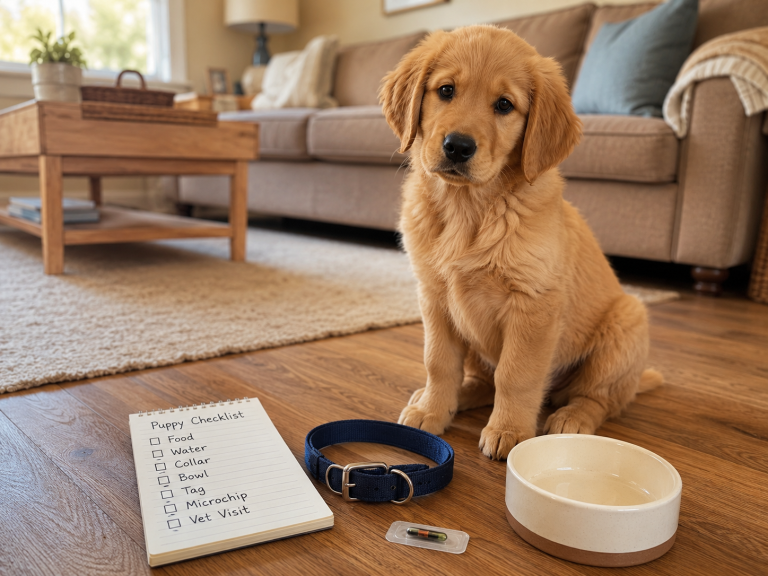
You have the bed picked out. The food bowl is ready. You have already decided on a name.
But here is the thing most new puppy owners find out the hard way getting excited and getting prepared are two different things. The supplies are the easy part. The steps that actually keep your puppy safe? Those are the ones people skip.
This checklist covers 3 things that matter most before your puppy comes home. Not the crate brand. Not the treat type. The things that protect your puppy if something goes wrong.
Step 1: Puppy-Proof Your Home Before You Open the Door
Your puppy has no idea what a power cord is. Or that the cabinet under the sink has cleaning products in it. Or that the gap behind the washing machine is a terrible place to squeeze into.
Puppies explore with their mouths. They move fast. And they will find every hazard in your home before you do.
Clear the Floor
Get down to puppy level and look at the space from their point of view. Remove anything chewable, swallowable, or toxic that sits below three feet. That includes:
- Electrical cords and chargers
- Shoes and small accessories
- Kids’ toys with small parts
- Any plants that are toxic to dogs (aloe, pothos, and lilies are common ones)
Secure What You Cannot Remove
For things you cannot put away trash cans, under-sink cabinets, low shelves use latches or baby gates to block access. A $10 cabinet latch is a much better fix than an emergency vet visit.
Set Up a Safe Zone
Before your puppy arrives, create one room or section of the home that is fully puppy-safe. This is where they sleep, eat, and spend time while they are still learning the rules. A crate, a playpen, or just a gated corner of the living room all work fine.
Do not try to give your puppy the run of the house from day one. That creates chaos for them and stress for you. A smaller, predictable space helps them settle faster.
Step 2: Book the First Vet Visit Within the First Week
Your puppy needs a vet visit, and it should happen fast ideally within the first five to seven days of coming home.
This is not just about shots. The first vet visit does three important things.
It Gives You a Health Baseline
A vet will check your puppy’s weight, ears, eyes, teeth, and overall condition. If there are any issues the breeder or shelter missed, you want to catch them early. Many pet health guarantees from breeders also require a vet check within a set window, so timing matters.
It Gets Vaccinations on Track
Puppies need a series of core vaccines in their first few months. Your vet will set up the right schedule based on your puppy’s age and current vaccination history. Missing or delaying vaccines leaves your puppy exposed during a period when their immune system is still developing.
It Gets the Microchip Implanted
If your puppy does not already have a microchip, this is the appointment where you get it done. The procedure takes about ten seconds. The vet uses a small needle to place a chip about the size of a grain of rice just under the skin between the shoulder blades. Your puppy will barely not
The chip stores a unique ID number. That number does nothing on its own. Which brings us to Step 3.
If you are thinking about cost, microchipping at a vet typically runs between $25 and $75. You can read a full breakdown of what to expect in dog microchip cost and affordable options.
Register your puppy’s microchip at NMR — it takes minutes →
Step 3: Register the Microchip Do Not Skip This Part
Most people think microchipping is the finish line. It is not. It is the starting line.
A microchip is just a number. When a shelter or vet scans your lost puppy and reads that number, they then look it up in a registry database. If your contact information is in that database, they call you. If it is not, the chip is useless.
According to a study published in the Journal of the American Veterinary Medical Association publicly cited on the NMR FAQ page — only 58.1% of microchipped animals brought into shelters were actually registered. That means nearly half of microchipped pets could not be returned to their owners — not because the chip failed, but because the owner never completed registration.
The same study found that the top reason reunification failed in registered cases was a wrong phone number on file. In 35.4% of cases where the chip was registered but the pet was not returned, the contact details were simply out of date.
What Registration Actually Involves
Registration means linking your puppy’s microchip number to your name, phone number, email, and address in a national database. That is what shelters, vets, and animal control officers search when they find a lost pet.
It is done online. It takes under five minutes. And with NMR, it is a one-time payment no annual renewals, no lapsing records.
How to Register With NMR
Go to nmr.pet/register, enter your puppy’s chip number (it is on your vet paperwork), and fill in your contact details. NMR is searchable nationwide, accepts all microchip brands, and its recovery line is available 24 hours a day at (800)-933-4541.
For a full walkthrough of the registration process, including what to do if your puppy came from a breeder who already registered the chip, see easy puppy microchip registration: complete guide to NMR online.
For details specific to registering a puppy’s chip versus an adult dog, see microchip registration for puppies at the National Microchip Registry.
Update It When Your Life Changes
The day you register is not the last time you need to think about this. If you move, change your phone number, or change your email, log back in and update your record. A registered microchip tied to an old number is no better than an unregistered one.
See NMR’s one-time registration plans and pricing →
The Window That Matters Most
Around 10 million pets go missing in the US every year, according to the American Humane Society. Estimates from animal welfare organizations suggest that 1 in 3 pets will go missing at some point during their lives. These numbers do not mean your puppy is about to disappear they mean preparation is always worth it.
Dogs with microchips that are properly registered are returned to their owners 52.2% of the time. Dogs without microchips are returned only 21.9% of the time. The data comes from the same Lord et al. study, publicly cited on the NMR FAQ page, covering more than 7,700 stray animals across 53 shelters.
Your puppy is going to be curious, fast, and occasionally unpredictable. You cannot control every moment. But you can make sure that if something goes wrong, the path back to you is clear.
Puppy-proof the space. Get to the vet in the first week. Register the microchip the same day it goes in.
Those three steps cost you less than an afternoon and they cover your puppy for life.
Register your puppy’s microchip at NMR — one time, no renewals →
Frequently Asked Questions
Q1. When should I take my new puppy to the vet for the first time?
Within the first five to seven days of bringing your puppy home. Early visits catch any health issues quickly, get vaccines on schedule, and allow you to ask questions before problems come up. Many breeder health guarantees also require a vet check within a set number of days.
Q2. Do I need to microchip my puppy if they already have an ID tag?
Yes. ID tags fall off, collars break, and tags wear down over time. A microchip is permanent and stays with your puppy for life. It cannot be removed, lost, or misread. Tags and microchips work best together, not as alternatives.
Q3. My puppy came from a breeder and already has a microchip. Do I still need to register it?
Yes, and this is one of the most common mistakes new owners make. If the breeder registered the chip, it is linked to their contact information not yours. You need to transfer the chip registration into your name at NMR.
Q4. How long does microchip registration take?
Under five minutes online. You need your puppy’s chip number (found on vet paperwork or your adoption documents), your name, phone number, email, and address. NMR sends you a confirmation once registration is complete.
Q5. Is NMR recognized by shelters and vets across the US?
Yes. NMR is part of the AAHA Universal Pet Microchip Lookup network, which means shelters and vets across the country can find your registration when they search your puppy’s chip number.
Q6. What do I do if I cannot find my puppy’s microchip number?
Ask your vet to scan your puppy at your first visit. They can read the chip number directly and give it to you. You can also check your adoption paperwork, vaccination certificate, or any documentation from the breeder or shelter.
Q7. Can I update my contact information after I register?
Yes, at any time. Log into your NMR account and update your phone number, address, or email whenever something changes. Keeping this current is just as important as registering in the first place.
Q8. What happens if my puppy’s microchip is not registered?
If your puppy gets lost and is brought to a shelter, the staff will scan the chip and search the number in a national database. If the chip is not registered, no owner information comes up and there is no way to contact you. The chip cannot help if it has never been linked to your name.
Q9. How do I puppy-proof my home before bringing a new dog home?
Start at floor level and remove anything chewable or toxic — cords, small objects, certain houseplants, and cleaning products stored in low cabinets. Add latches to cabinets you cannot clear out. Set up one safe, gated space where your puppy will spend most of their time while they learn the layout of your home.
Q10. What is the most important thing to do in the first 48 hours after bringing a puppy home?
Register the microchip if it is not already done. Keep the space calm and predictable. Book the vet appointment if it is not already scheduled. The first 48 hours set the tone your puppy is adjusting to a new environment, so consistency and safety matter more than excitement and activit