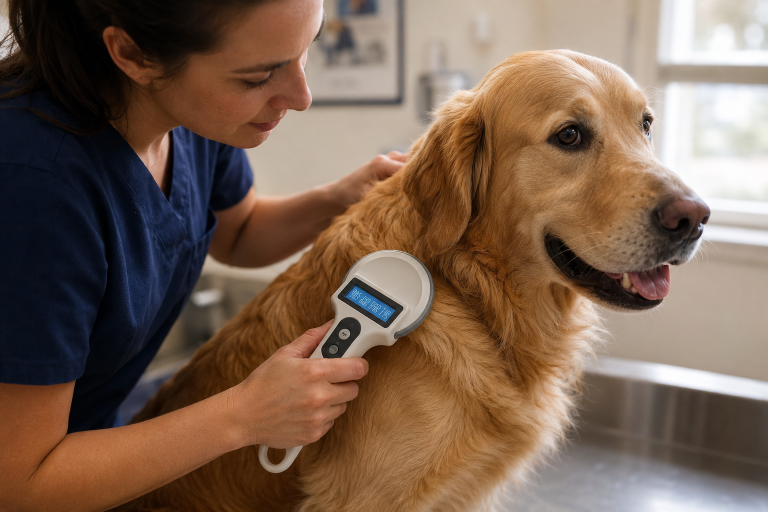
A dog slips out of a backyard in the middle of a Tuesday afternoon. By evening, a stranger has found him three streets away and dropped him at the nearest animal shelter. The staff scan his shoulder with a small handheld device. A number appears on the screen.
What happens next depends entirely on one thing whether that number leads somewhere.
That 30-second scan is the moment everything either works or falls apart. Understanding what happens during it, and what the shelter does after, is the difference between a reunion and a dog sitting in a kennel for days while his owner has no idea where he is.
What Does a Microchip Scanner Actually Do?
The chip inside your dog is about the size of a grain of rice. It sits just under the skin, usually between the shoulder blades. It has no battery. It does nothing on its own.
When a scanner passes over it, the scanner sends out a small radio signal. That signal powers the chip just enough for it to transmit one thing a number. Usually 9, 10, or 15 digits long. That number is called the microchip ID.
This technology is called RFID Radio Frequency Identification. It just means a tiny chip that sends a signal when a radio wave hits it. The same basic idea is in your office key card or a contactless credit card. In your pet, it’s permanent, passive, and impossible to lose.
The scanner reads the number in under a second. No pain, no reaction from the dog. The number shows up on the scanner’s screen.
That’s all the chip does. It gives a number. Nothing else.
Where Does That Number Go Next?
Here’s what most pet owners don’t realize — the microchip itself does not contain your name, your phone number, or your address. The chip only holds that ID number. Your contact details live somewhere else entirely: in a registry database.
After the scanner shows the number, the shelter staff has to look it up. They type it into a registry lookup tool — either one they use internally or a universal search like the AAHA Universal Pet Microchip Lookup. That search tells them which registry the chip is listed in, if any.
If the chip is registered, the registry shows the owner’s contact information. The shelter makes a call. You come pick up your dog.
If the chip is not registered or if it’s registered in a database the shelter can’t access — that number leads nowhere. Your dog has a chip. The chip has a number. The number has no name attached to it.
This is exactly why how microchip registration works matters as much as the microchip itself. The chip is just the key. Registration is the door it opens.
Check if your pet’s microchip is already registered at NMR — free lookup
What Information Does the Registry Actually Show?
When a shelter or vet pulls up a registered chip, here’s what they see on their screen:
|
Registered pet |
Unregistered pet |
|
Owner’s full name |
No name |
|
Primary phone number |
No contact details |
|
Secondary/emergency contact |
No backup number |
|
Pet’s name and description |
Chip number only |
|
Veterinarian details (if added) |
No medical history |
|
Address on file |
No location data |
The difference is stark. A registered chip gives the shelter everything they need to make one phone call and close the case. An unregistered chip gives them a number they can’t do anything with.
Some registries also let you store medical records alongside your contact details. NMR’s Health Vault Registry at $50 does exactly that — so if your pet is found injured, the vet treating them can also see vaccination records, medications, and any known conditions. That’s not just useful for reunification. It’s useful for your pet’s immediate care.
The more complete your registry entry, the faster and smoother the whole process goes.
Why Some Scans Lead to a Reunion — and Others Don’t
A large study published in the Journal of the American Veterinary Medical Association looked at over 7,700 stray animals across 53 shelters. The numbers are worth knowing.
Dogs with microchips were returned to their owners 52.2% of the time, compared to just 21.9% for dogs without chips. That’s more than double the return rate. For cats, the gap is even larger — 38.5% versus 1.8%.
But here’s the part that doesn’t get talked about enough. The same study found that only 58.1% of microchipped animals in shelters were actually registered. Nearly half of all microchipped pets had a chip that led nowhere.
And among the microchipped pets that still weren’t reunited with their owners, the single biggest reason was a wrong or disconnected phone number — 35.4% of failed cases.
The chip worked. The scanner worked. The registry had a record. But the number on file had changed, and nobody had updated it.
This is the part of the system that breaks down most often. Not the technology. Not the scanner. The human step — making sure the registry has your current details.
Register your pet’s microchip at NMR — one time, no renewals
How to Make Sure Your Pet’s Scan Leads Back to You
The scan itself will always work if the chip is intact. What you control is everything that happens after the number appears on that screen. Here’s what you need to have in place:
|
Step |
What to do |
Why it matters |
|
1. Confirm your chip is registered |
Run a free lookup at NMR |
Many pets are chipped but never registered |
|
2. Check your contact details |
Log into your registry account and verify your phone number |
Wrong number is the #1 reason reunions fail |
|
3. Add a secondary contact |
Enter a backup person who can be reached if you’re unavailable |
Gives shelters a second option |
|
4. Choose a nationally searchable registry |
Make sure your registry is accessible to shelters across the US |
A local or closed registry limits who can find you |
|
5. Update after any life change |
New phone, new address, new owner — update your record |
Outdated info is the same as no info |
NMR is searchable by shelters, vets, and animal control officers across the US, 24 hours a day. The recovery line — (800)-933-4541 — is available around the clock. One registration, no renewals, no lapsing records.
If you’ve recently adopted a dog and you’re not sure whether the chip is in your name, check now rather than after something goes wrong. You can read more about whether your pet’s microchip is registered and what to do if it isn’t.
Understanding the full picture of the benefits of microchipping your pet goes beyond just reunification — it covers travel, legal identification, and peace of mind.
Frequently Asked Questions
Q1. What does a microchip scanner read?
It reads a unique ID number usually 9 to 15 digits stored on the chip. It does not read your name or contact details.
Q2. Does scanning a microchip hurt the pet?
No. The chip is passive and has no battery. Most pets don’t react at all when scanned.
Q3. Can any shelter scan my pet’s microchip?
Most shelters, vets, and animal control offices in the US carry universal scanners that read all standard chip frequencies.
Q4. What if my pet’s chip isn’t registered?
The scan will produce a number, but it won’t lead anywhere. You can register at any time through NMR’s registration page — one-time fee, no expiry.
Q5. How do shelters know which registry to search?
Most use the AAHA Universal Pet Microchip Lookup, which searches multiple registries at once. NMR is included in that search.
Q6. What happens if my contact details are out of date?
The shelter gets your old information and can’t reach you. Log into your NMR account to update your details anytime.
Q7. Can a microchip store medical records?
he chip only stores an ID number, but your registry entry can hold more. NMR’s Health Vault Registry at $50 lets you store vaccination records, medications, and more alongside your contact details.
Q8. Does microchip registration expire?
Not at NMR. It’s a one-time payment with no renewal fees and no expiry date.
Q9. What if my pet was microchipped by a breeder or rescue?
The chip may still be in their name. Run a free lost and found lookup to check, and transfer it to your name if needed.
Q10. How often should I check my pet’s microchip registration?
Once a year and immediately after any change to your phone number, address, or if you’ve adopted a new pet.
The scan takes less than a second. What comes after it — the lookup, the call, the reunion — takes a little preparation on your end. Make sure your number is in the right place before you ever need it to be.
Give your pet complete protection with the Total Protection Kit — $89